Good tools. 50 practical choices for serving, cleaning, learning and small-batch brewing. Start with what you need, not a drawer full of gadgets.
Editorial selections, not hands-on test results. Links marked “paid link” may earn us a commission. Check current price, seller, variant and delivery on Amazon.
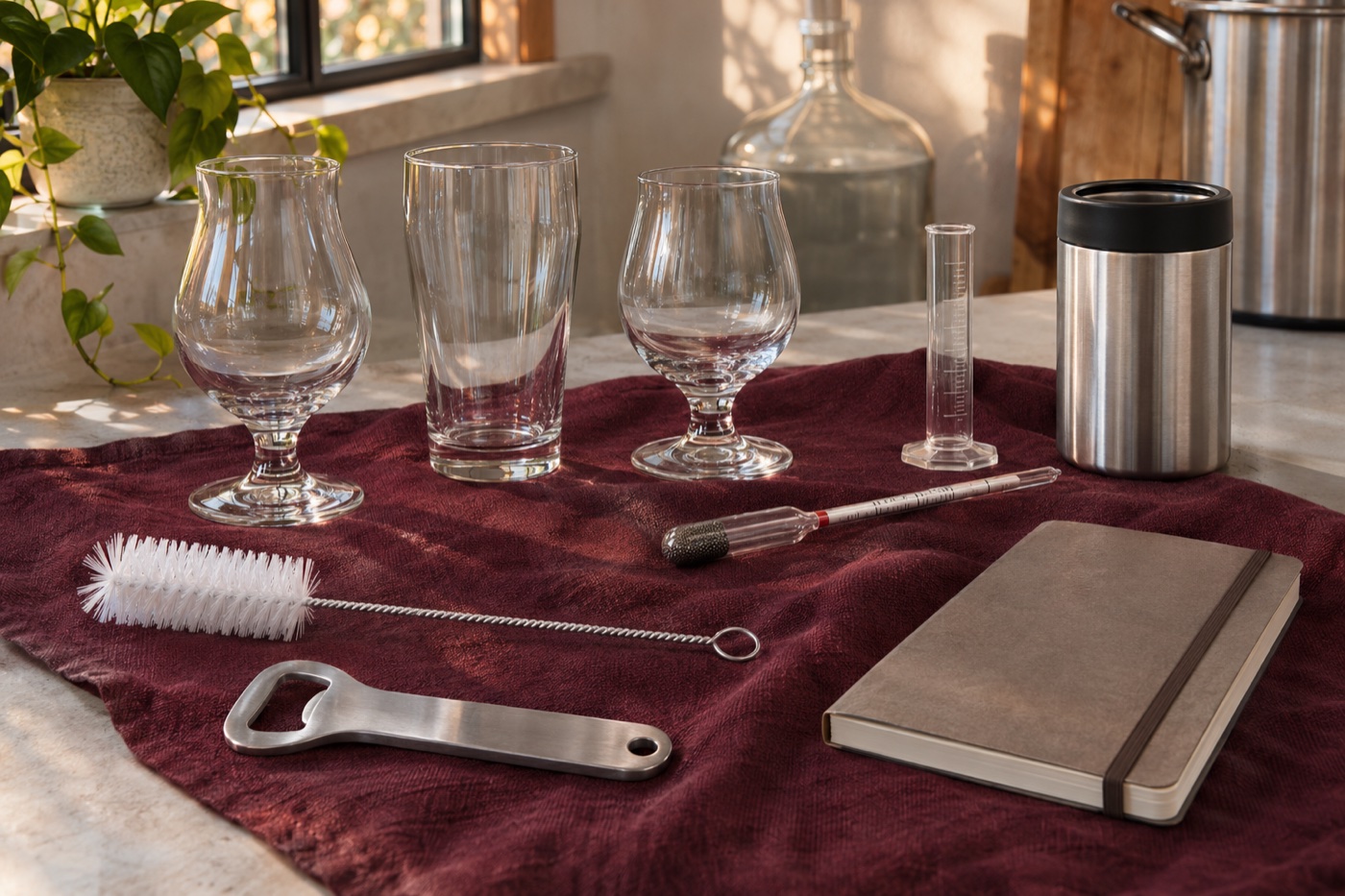
AI-generated editorial scene. Illustrative tools, not exact products. Glassware Serving tools Cleaning Brewing tools Books Fermentation Bottling Kegging Tasting flights Drink coolers Glassware Libbey Craft Brews assorted beer glasses, set of 6 Different glass shapes let a home tasting compare serving styles without buying six separate sets.
Before you buy: An assorted set gives fewer matching glasses for serving a group the same beer.
Libbey Craft Brews Classic Belgian glasses, set of 4, 16 oz A matching set of stemmed tulip glasses suits a small tasting where everyone uses the same shape.
Before you buy: The nominal capacity includes headspace; leave room for foam rather than filling to the rim.
Libbey Beer Tasting Sampler Glass #249, 5 oz, set of 8 Eight small glasses make a side-by-side tasting easy to arrange.
Before you buy: These are sample glasses rather than full-pint serving glasses.
G.E.T. P-05-CL Plastic Mini Pilsner Glasses, 5 oz, set of 12 Plastic tasting vessels offer an alternative where breakable glass is inconvenient.
Before you buy: Plastic does not provide the same feel at the rim as glass.
Libbey Mini Pub Glass 4809, 5 oz, set of 12 Matching small pub glasses support consistent presentation across samples.
Before you buy: Small capacity makes these better suited to tasting pours than full servings.
Cool Flights Beer Flight Glasses Dedicated tasting glasses can supplement a flight station.
Before you buy: Check the pack count and caddy compatibility on the selected listing.
Cleaning OXO Good Grips Bottle Brush A flexible neck and two bristle textures help reach inside reusable bottles and taller glasses.
Before you buy: Check the brush-head width against narrow bottle necks; cleaning does not replace brewing sanitation.
Five Star Star San, 32 oz Helps sanitize already-clean brewing equipment before it contacts cooled wort.
Before you buy: Follow label dilution and contact time; sanitizer does not remove brewing residue.
Five Star PBW Liquid, 32 oz Liquid brewery cleaner helps loosen residue in brewing vessels and transfer equipment.
Before you buy: Cleaning is separate from sanitizing; follow label dilution, materials compatibility and rinsing.
28-inch carboy cleaning brushes, pack of 2 Long brushes reach into deep glass brewing vessels that a short kitchen brush cannot.
Before you buy: Confirm surface compatibility before use; stiff brushes can scratch some plastics.
OXO Good Grips Aluminum Frame Bottle Drying Rack A dedicated rack gives washed reusable bottles an organized place to drain.
Before you buy: Check bottle dimensions and stability before using it with heavy growlers.
OXO Good Grips Water Bottle Cleaning Set Multiple brush sizes help clean reusable bottle bodies and small lid recesses.
Before you buy: Brush cleaning alone does not sanitize equipment used for brewing.
Books Tasting Beer, 2nd Edition — Randy Mosher A reference for learning beer styles, sensory vocabulary and food pairings alongside the catalogue.
Before you buy: It is a 2017 edition, so it is not a current brewery directory or live buying guide.
How To Brew, 4th Edition — John J. Palmer A process-focused reference for planning ingredients, equipment and homebrewing methods.
Before you buy: Its detail rewards study; it is a book rather than a ready-to-use brewing kit.
Brewing Classic Styles — Jamil Zainasheff and John Palmer Style-focused recipes give brewers a starting point for planning repeatable batches.
Before you buy: Older style definitions may differ from current competition guidelines.
Designing Great Beers — Ray Daniels Recipe-design tables help connect ingredient choices with classic style targets.
Before you buy: A technical older reference; it does not cover every newer beer style.
American Sour Beers — Michael Tonsmeire Explains approaches to mixed fermentation for brewers interested in sour-beer production.
Before you buy: A specialist reference; sour brewing often needs extra time and careful equipment separation.
For the Love of Hops — Stan Hieronymus Connects hop choices and brewing methods with aroma and bitterness.
Before you buy: New hop varieties and current crop specifications require additional sources.
Brewing Better Beer — Gordon Strong Process-focused lessons support brewers who want to diagnose and improve repeated batches.
Before you buy: Best suited to readers who already know the basic brewing sequence.
Brew Like a Monk — Stan Hieronymus Provides background and brewing context for exploring Belgian-inspired ales.
Before you buy: A focused style reference, not a complete beginner equipment guide. The offer checked was used; inspect condition and seller before buying.
Malt — John Mallett Explains malt production and properties to support more deliberate grain selection.
Before you buy: Ingredient specifications still vary by supplier and batch.
Modern Homebrew Recipes — Gordon Strong Recipe examples help brewers compare mashing, hopping and formulation choices.
Before you buy: Recipes need adjustment for equipment efficiency and available ingredients.
Radical Brewing — Randy Mosher Offers creative recipe directions for brewers ready to experiment beyond a standard kit.
Before you buy: Experimental ideas require small trials rather than an assumption of identical results.
Historical Brewing Techniques — Lars Marius Garshol Documents traditional farmhouse methods that broaden a brewer's understanding of process.
Before you buy: Historical practices need interpretation for modern equipment and local conditions.
Brewing with Wheat — Stan Hieronymus Helps compare wheat-beer traditions and the ingredient decisions behind them.
Before you buy: Focused on wheat styles rather than a general brewing course.
IPA — Mitch Steele Combines IPA history and recipe perspectives for planning hop-forward beers.
Before you buy: It predates many recent IPA developments and is not a current hop-market guide.
Fermentation INKBIRD ITC-308 temperature controller Separate heating and cooling outputs support a temperature-controlled fermentation chamber.
Before you buy: Needs compatible heating/cooling equipment; check electrical ratings and probe placement.
Strange Brew Fermonster PET carboy, 7 gal A wide opening makes a larger homebrew fermenter easier to inspect and clean.
Before you buy: PET needs compatible cleaning tools and temperatures; check included lid and airlock accessories.
Tilt Wireless Black Hydrometer and Thermometer Floating wireless readings help track fermentation trends without repeatedly drawing samples.
Before you buy: Bluetooth range and calibration matter; a reading trend does not guarantee fermentation is finished.
FE650 fermentation heater, 40 W A flexible heater can add warmth to a fermentation vessel in a cool room.
Before you buy: Use suitable temperature control and follow the installation instructions; it does not provide cooling.
Bottling FastRack Ferrari Super Agata bench capper An adjustable bench mechanism supports repeatable capping across compatible bottle heights.
Before you buy: Check cap and bottle compatibility; it is not designed for every closure type.
Spring-loaded beer bottle filler A contact-operated filler helps control flow when filling homebrew bottles.
Before you buy: Requires matching tubing and a suitable liquid source; clean and sanitize its valve.
Kegging 3741-BR dual-gauge primary CO2 beer regulator Separate pressure gauges help set up a compatible draft-beer gas supply.
Before you buy: Cylinder, connectors and hoses must match; use only within the rated gas and pressure specifications.
Tasting flights Owlgift Beer Flight Glasses and Board Set, set of 2 Two handled trays help carry separate flights to the table.
Before you buy: Wooden trays need storage space beyond the glasses alone.
D'Eco Beer Tasting Flight Sampler Set, two boards and eight glasses Chalkboard panels provide a place to identify each pour.
Before you buy: Chalk and storage space for both boards must be considered.
MyGift Torched Wood Beer Flight Board Set, set of 2 Two boards let two tasters compare their own flights.
Before you buy: Chalkboard labels need wiping between different tastings.
True Beer Flight Set with Four 5 oz Glasses and Wooden Board A coordinated board and glasses simplify setting up a small tasting.
Before you buy: Four positions limit the number of beers served in one flight.
Cool Flights Beer Flight Caddy A dedicated caddy groups tasting glasses for transport.
Before you buy: Confirm the exact listing contents before assuming glasses or cooling packs are included.
Drink coolers BrüMate Hopsulator Bott'l Insulated Bottle Cooler, 12 oz A bottle-specific insulated holder helps separate your hand from the cold bottle.
Before you buy: It is designed for standard 12 oz glass bottles, so unusual bottle shapes may not fit.
Asobu Frosty Beer Holder 2 Go A holder with a bottle opener combines two practical accessories for outdoor serving.
Before you buy: Verify the bottle or can fit before choosing it for a particular drink.
Huski Beer Cooler 2.0, brushed stainless A can-and-bottle holder offers flexibility when switching between common drink containers.
Before you buy: Larger tall cans require a different size of holder.
These selections complement the beer archive. Product availability varies by seller and destination; the catalogue’s beer records are not Amazon inventory.